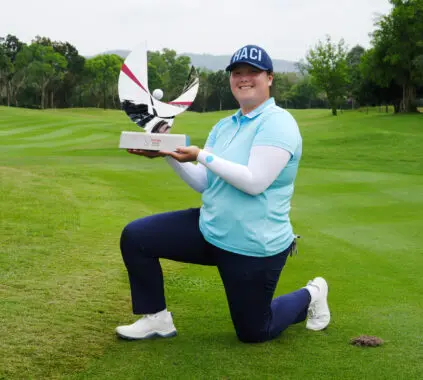

LPGA Tour rookies Leah John (left) and Hailee Cooper competing on the Epson Tour. Photo: Isaiah Bell / Epson Tour
Inside the grueling, beautiful, financially brutal journey to the LPGA Tour
In phone conversations in late December 2025, Cooper and John shared their stories of making it to the LPGA Tour—the financial sacrifices, the mental battles, and the people who helped them survive the grind.
Hailee Cooper had just earned her LPGA Tour card, and she was driving through Texas in a truck that had seen better days. The windows didn’t roll down anymore. The climate control was dead. But Cooper wasn’t complaining—not really. This beaten-up vehicle was part of the story of how she got here.
A few thousand miles away, Leah John was in Palm Springs, finally able to answer the question everyone kept asking her: What do you do?
“My favorite thing in the world is when people ask me what I do,” John says, and you can hear the genuine excitement in her voice. “I say, ‘I play on the LPGA Tour.’ I’m just so excited to tell them. They’re like, ‘Oh my gosh, that’s incredible.’ And I’m like, ‘I know. I feel the same way.'”
It’s a small thing—being able to claim that title. But when you’ve spent years grinding through developmental tours, eating rotisserie chicken and yams in hotel rooms, wondering if you’ll ever make it, finally getting to say those words means everything.
Both women are part of the 2026 LPGA rookie class. Both came up through the Epson Tour, the developmental circuit that serves as the final proving ground before the big leagues. And both know something that most casual golf fans don’t: that making it to the LPGA Tour requires not just exceptional talent, but the financial resilience of a startup founder, the mental fortitude of a combat veteran, and the logistical skills of a field general.
This is their story. But it’s also the story of every woman who’s ever chased the dream of playing professional golf at the highest level—a dream that comes with a price tag most people can’t imagine.
What strikes you immediately about both Cooper and John is how grounded they are. These are women who’ve spent years scraping by, sharing Airbnbs, eating the same meals week after week, and they’re about to compete alongside Nelly Korda and Lydia Ko. And yet there’s no bitterness in their voices when they talk about the struggle—just a clear-eyed understanding of what it took to get here.
Most people don’t understand the toll—financial and mental—of qualifying for the LPGA Tour. The developmental circuit isn’t just about proving you can play golf at an elite level. It’s about proving you can survive the grind without breaking.
The Money: Hemorrhaging Cash for the Chance to Compete
The numbers are staggering when you lay them bare.
Hailee Cooper spent approximately $75,000 to $80,000 during her 2024 Epson Tour season. And that was on the low end. The year before, playing only half a season, she burned through $35,000. She was staying in host houses whenever possible, driving instead of flying, using gas discount cards, scrounging every deal she could find.
“I had ten thousand dollars in my bank account, and I thought I was living right,” Cooper says with a laugh. “I’m like, ‘We are living right. This should be able to fund the whole year for me.’ And then, after I won my first professional event, I realized, ‘Oh my gosh, I just don’t have the funds.'”
Leah John, a Canadian competing in U.S. dollars, faces an even steeper climb. When she won the Four Winds Invitational this year and took home $33,750, people saw the number and thought she was flush. The reality was different.
“Yeah, I know it’s funny,” John says. “People look at that like, ‘Wow, that’s amazing.’ I’m like, ‘Yeah, well, I get taxed 30 percent as an international.’ So there goes a big chunk. And then a tournament week can cost three to four thousand dollars. And that’s American dollars. I’m Canadian, so the exchange rate makes it much more expensive for me to compete in the U.S.”
She pauses, searching for the right metaphor.
“That money definitely starts to go away real quick. It’s like having a hemorrhage.”
John estimates she broke even for the year—and only because she was strategic about every dollar. The Epson Tour covered her stage three Q-school fee. She skipped having a full-time caddy for stretches of the season. She used host families for housing. And then there were the groceries.
“It’s a joke, but it’s not,” she says. “I eat chicken and yams like every single day. I know I can get a rotisserie chicken and a bag of yams anywhere. And I just rocked that.”
It sounds simple—maybe even monotonous. But there’s a logic to it that makes perfect sense when you’re living on the road, counting every dollar. The same meal, every day, in every city. One less decision to make. One less variable to worry about. When everything else in your life is uncertain—whether you’ll make the cut, where you’ll sleep next week, if you can afford to keep going—knowing exactly what you’ll eat becomes a small anchor of stability.
The Caddy Calculus: When $1,200 a Week Breaks the Budget
One of the starkest financial decisions for Epson Tour players is whether to employ a caddy. On the men’s Korn Ferry Tour, the developmental equivalent, caddies are standard. On the Epson Tour, they’re often a luxury players can’t afford.
Cooper partnered with MGI, a company that makes electric push carts—the kind that follow you around the course like a robotic assistant. She named hers Cheryl.
“There was actually a couple really mean comments on some social media posts that the Epson Tour made about MGI,” Cooper recalls. “There was a guy at the bottom who was like, ‘These electric cars are taking caddy jobs.’ And I’m like—we don’t make enough money on the Epson Tour. Like, me personally, I didn’t have a ton of money to go out and just start playing golf.”
She does the math out loud: caddies on the Epson Tour typically get paid $1,200 a week, plus a percentage of any winnings. That barely covers their own expenses—travel, lodging, food. The players themselves can’t afford to cover those costs on top of their own.
“I couldn’t afford to hire a caddy for twelve hundred dollars every week out there,” Cooper says. “I just can’t. The MGI cart? They were offering them to girls for eight hundred dollars at one point. That’s what I’d pay for one caddy for one week. So I was like, I can take the physical burden off of me and use it for the whole season.”
John made the same calculation. She had a wonderful caddy named Troy from Pinehurst, but after starting the season by missing four consecutive cuts and hemorrhaging money, she made a decision.
“I hadn’t been playing well, I wasn’t making any cuts, I wasn’t making very much money,” John says. “So I decided I needed a break from that expense. Him and I took a break. He hopped on some other players’ bags, which was great. And then once I got my bearings, I started making more cuts, but at that point I’d gotten comfortable being on my own, and I didn’t want to introduce another variable.”
She went on to win a tournament—alone, pushing her own cart, reading her own putts.
Finding Home on the Road: The Host Family Lifeline
If there’s an unsung hero in the developmental tour ecosystem, it’s the host families—the strangers who open their homes to professional golfers week after week, asking nothing in return but the pleasure of their company.
Cooper’s first Epson Tour event, she got placed with an elderly couple—he was 87, she was 86—who took her in on short notice when the tournament ran out of housing slots. She was terrified. She’d never stayed with a host family. She was traveling alone. And she showed up to find a couple who cooked for her every night, asked about her practice rounds, and made her feel like she was visiting grandparents.
“They text me still,” Cooper says. “They texted me ‘Good job, congratulations!’ when I got my card. They’re the sweetest couple. I cried at like four different host houses this year leaving because I’m just like, I don’t want to leave. Y’all are so sweet.”
In Alabama, a host mother asked Cooper what she liked to eat. Cooper tried to demur—please don’t feel obligated. The woman wouldn’t hear it.
“She’s like, ‘Haley, we are literally gonna have food for you every day, like every meal. What snacks do you want? Because I’m buying them right now.’ I said, ‘Okay, I like frozen peanut butter jelly sandwiches. You can get a ten-pack of Uncrustables and get me three apples.’ She goes, ‘Perfect. Anything else?’ Beef jerky, dried fruit—she had just all these things.”
That week, Cooper spent $50 total. Fifty dollars. Just gas for her car. Everything else—housing, food, snacks—was covered by a stranger who simply wanted to support a young golfer chasing her dream.
But the host families provide more than financial relief. For players traveling alone, grinding through a lonely season, they provide something money can’t buy.
“Having people around me to literally chat with and just talk it out—it helps me. Especially when I didn’t have a caddy with me. It’s like having my own family on the road.”
John used host families for roughly 30 to 40 percent of her season, particularly early on when money was tightest. She found the same thing Cooper did: normalcy. A sense of home. Someone to eat dinner with who didn’t want to talk about golf.
“For the most part, I really enjoyed having them bring a sense of normalcy into my daily life,” John says. “Maybe it’s a sit-down dinner, or just coming back to a home. It can be really comforting. Some families understood the gig—when we come back at the end of the day, we kind of want some downtime, maybe not talk so much about golf. Those are really great.”
She adds, almost as an afterthought: “And also, knowing that you’re in a safe area with safe people. It was nice.”
One host mother in Indiana—a woman named Mindy—became so close to John that she stayed with her again the following year, and then again in Arizona. During one visit, they were watching Happy Gilmore together when a scene came on where a character does the splits. Mindy stood up and did the splits herself, right there in the living room.
“It was crazy,” John laughs. “I’m definitely going to miss that entertainment. The hotel concierge probably isn’t going to be doing the splits for me.”
The Breaking Point: When Walking Away Felt Like the Only Option
The financial pressure is crushing. But it’s the mental toll that nearly ended Hailee Cooper’s career before it truly began.
In 2021, Cooper was at the University of Texas, miserable, her game falling apart along with her sense of self. She didn’t just want to transfer. She wanted to quit golf entirely. Hang up the clubs and walk away from the game she’d played since she was eight years old.
“I just wasn’t in a good spot mentally,” she says. “I really wanted to quit. I had almost—I really wanted to quit. I told my dad, ‘I really think I just want to quit. I don’t think I want to play golf anymore.'”
It’s sobering to think about: if not for one person, at one moment, saying the right thing, Cooper might not be on the LPGA Tour today. She might not be playing professional golf at all.
Her father suggested she enter the transfer portal, just to see what happened. The first call came from Gerrod Chadwell, then at the University of Houston. Cooper was honest with him: she didn’t know if she even wanted to golf anymore.
“He said, ‘Give me one semester and just see what happens.'”
That conversation changed everything. When Chadwell took the job at Texas A&M shortly after, Cooper followed him. And something shifted.
“He’s a very emotional guy, and so am I,” Cooper says. “We cried a couple times together, in the best way. He looked at me and said, ‘I really don’t care if you get any better results. If your golf game doesn’t improve, I really don’t care.’ He’s like, ‘I just want to see the spark in you that I used to see. And I know that being here, we can get that back for you.'”
She started crying as he said it.
“That’s crazy, because no one’s ever really said that to me,” Cooper recalls. “In college, even though you have your team around you, it is so lonely when it comes to mental stuff. And he just completely was like, ‘We’re gonna do everything in our power—financially, whatever it takes. We’re gonna get you all the resources that A&M can give you. We’re gonna get you back to where you need to be. And if that helps with your golf, great. If not, we’re gonna get the person—your personality—back.'”
She adds: “I think I was just a super broken person. I was just like, ‘This is not—’ It’s a very vulnerable time in our life, from 18 to 25. So much is changing and shifting. You’re going off to college, you’re not with your parents anymore, you’re being told what to do by other people. And I think it was just very lonely. COVID didn’t help either.”
Cooper still talks to Chadwell regularly. His wife, Stacy Lewis—the World Golf Hall of Famer—has become a mentor. Cooper babysits their daughter.
“I always tell him—he’s like, ‘No, it’s you.’ But I’m like, ‘No, really. If you didn’t give me that semester, I was gonna hang up the clubs. I was gonna be done.'”
The Grind: 22-Hour Drives and Taco Bell Opens
The life of a developmental tour golfer is one of constant motion. You’re never home. You’re always somewhere else, always driving or flying or checking into another hotel or someone’s guest bedroom.
Cooper’s father has been driving her to tournaments since she was eight years old. He’s a man who, by her account, should have been trucker in another life.
“We always say he was a NASCAR driver in a previous life,” Cooper laughs. “But really, he should be a truck driver because he can just go all night. He puts on Luke Combs on repeat and just listens to him, and I’ll fall asleep in the passenger seat.”
Once, after visiting family in New Jersey, her father drove 22 hours straight back to Texas. Didn’t stop except to use the bathroom. Just Luke Combs and the open road.
For the Epson Tour, Cooper drove from Texas to Michigan for a stretch of tournaments—a journey that saved her over $2,000 compared to flying and renting a car. She never drove more than 15 hours alone, but 12-hour solo drives were routine.
“We’ve always been huge drivers,” she says. “I know next year, with the LPGA schedule, I won’t be able to drive as much. I’ll definitely be flying.”
The mini-tour circuit that preceded her Epson career took her to even stranger places. The WAPT—the Women’s All Pro Tour—sent her to Natchez, Mississippi, for something called the Taco Bell Open.
“It was in the middle of nowhere,” Cooper recalls. “I had to drive 20 minutes from the hotel. And there wasn’t even a Taco Bell there. The only fast food they had was a Church’s Chicken in a gas station. And I was like, ‘You know what, the gas station looks a little sketch. We’re not gonna go.'”
She laughs at the memory. “It was really cute, I guess. But not my first choice.”
The time warp is real. Cooper describes the strange sensation of being on the road for so long that she loses track of the calendar entirely.
“My first year of pro golf, we made it to October, and my brain was still back in June,” she says. “It’s funny—while you’re on the road, it feels like forever. You’re gone for so long. But then as soon as I’m home, I’m like, my brain is still back in June. I feel like no time has passed because I wasn’t at home.”
The Moment Everything Changed
Hailee Cooper walked off the 18th green at the U.S. Women’s Open with tears in her eyes. She had just tied for seventh at a major championship—the biggest moment of her career. She wasn’t thinking about the money.
“I wasn’t even thinking about the money,” she says. “I was just like, ‘Oh my gosh, I just got into the Open for next year.’ Like, that’s what I was so excited about.”
Then she walked into the scoring tent. The other players had left. The official on duty asked if she wanted to see how much money she’d made.
“I started shaking. I was like, ‘I don’t know, do I want to see it?’ They pushed over a little paper they had printed out. And I was like, ‘Oh my gosh, there’s a three. And then there’s a couple zeros behind it.'”
It was over $300,000.
“It didn’t really process how much money it was at first,” Cooper says. “I was like, ‘This is life-changing.’ Like, I don’t have to stress about travel anymore. If there’s a place I can’t get a host house, I don’t have to play for my hotel next week.”
She looked at her dad and said she was finally going to get him a new car.
That broken truck? He still has it—he’s being picky about what he wants, she says. But Cooper bought herself a used Toyota Highlander and gave her mom her RAV4. Finally, the family has reliable transportation.
More than the material relief, the U.S. Women’s Open windfall freed Cooper mentally for the rest of the season.
“It did a lot,” she says. “I immediately put it into a financial advisor’s hands. But I felt a lot better about my travel, about affording the grind.”
She went on to secure her LPGA Tour card through the Epson Tour.
Welcome to the Show: China, Rookie Orientation, and the Dream Realized
The 2026 LPGA Tour season begins, fittingly, with a test: Blue Bay in China. Welcome to the big leagues—now fly 30 hours to play your first event.
“It’s like, ‘Here you go. Go to China,'” Cooper laughs. “I’m like, okay, I mean, I definitely want to play in it. I’ve never been to China, and I think that’d be really fun.”
The tournament flies them first class and covers the cost. Cooper sees the silver lining: “The flight’s free for me. I get to say I went to China. Let’s just do it.”
After China, the tour swings back to Arizona and California—a more familiar circuit. Cooper has already lined up a caddy for the season: Mercer Leftwich, a veteran who worked with Patty Tavatanakit. He’s coming from Louisiana to practice with her before the season starts.
“I told him, ‘I literally just need someone to shoot the shit with when we’re out there, and then, hey, I don’t know where this putt’s breaking—I need you to help.’ He said, ‘Perfect. I’m the guy for the job.'”
John is taking a different approach for China. Her regular caddy, Troy, will start with her in the United States. For China, she’s bringing her coach.
“It’s expensive going out to China,” she says. “And it’s a lot to ask of a caddy to go all the way to China and then just come right back to the U.S. Maybe just start the season in the U.S., make it easier all together.”
Both women are looking forward to rookie orientation. Cooper, characteristically, is excited about the administrative details.
“Some people probably hate rookie orientation,” she says. “But I’m so ready for rookie orientation because I really want to be organized and get all my stuff together, so I don’t mess anything up. That’s probably what I’m most terrified about—not signing up for a tournament on time or something.”
The LPGA assigns rookies to “pods”—small groups paired with a veteran player who can guide them through the nuances of tour life. What can you write off? Which tournaments should you play? What’s the etiquette when you accidentally park in a major champion’s spot?
“It’s to make sure you don’t feel alone out there,” Cooper says. “Luckily, we have a really cool rookie class from the Epson Tour, and I’m friends with a bunch of those girls. Like Leah John, and Riley Smith, and Melanie Green. We were really close this year, so I’m really glad we’re kind of going in together.”
The Advice They’d Give: Keep the Joy, Find Your People
When asked what advice they’d give to someone starting out on the Epson Tour—someone staring down the same financial pressures, the same mental battles, the same lonely road—both women circle back to the same themes.
“Get yourself ten thousand dollars in an account,” Cooper says bluntly. “Get every host house you can. Share Airbnbs with girls if you can’t get a host. Share everything. Be really careful.”
But then she shifts. The practical advice only goes so far.
Somewhere along the way, Cooper’s relationship with the game changed. The mental shift wasn’t about technique or strategy—it was about remembering why she started playing in the first place.
“Once you do that—yes, it’s a job, but I was always told: love what you do, and you’re never gonna work a day in your life,” Cooper says. “I’ll only do this as long as I love it. If I stop and I don’t want to do it, I never want to hate golf.”
She talks about the importance of keeping competitions fun, of going out to see the places you’re traveling to, of not just sitting in your hotel room and sulking after a bad round.
“Little girl me is freaking out,” she says. “Like, this is the coolest job I could ever have. Really take that in and enjoy what you’re doing.”
John’s advice is simpler, almost Zen.
“There’s a lot of power in believing that everything’s going to work out the way you want it—just not the way you planned it,” she says. “I wanted to get to the LPGA Tour by the end of the season. I was planning to have this incredible start. I missed all four cuts. That plan got flipped on its head.”
She pauses.
“But I still ended up where I wanted to be. I started to prioritize my value system more—playing in a way that gave me joy. It’s easy to get caught up in the money, the numbers, the scores. But if anything, you should just keep sticking to what\’s gotten you there in the first place, and growing as a player and a person.”
The Dream, Realized and Ongoing
In a few weeks, Hailee Cooper and Leah John will board planes to China. They’ll play their first official LPGA Tour events. They’ll stand on tees alongside Nelly Korda and Lydia Ko, the best players in the world.
Cooper has already started making her goals for the year. She’s always wanted to win the major now known as the Chevron Championship—ever since she watched her mentor Stacy Lewis win it when it was still called the Kraft Nabisco.
“I’m living my dream,” she says. “I’m going to be living my dream next year, whether it goes the way I want it to or not. I’m going to be super grateful for it. But I still have more that I want to do. I want to grow the game and get more girls involved in golf. There’s a lot more that I feel like we can do.”
“God has been very good to me and I’m so blessed to have the support system I do.”
The broken truck is still in Texas. The rotisserie chickens will still be purchased at Walmart. The host families will still open their doors. And the dream will continue—expensive, exhausting, and entirely worth it.
“I’m not scared,” Cooper says. “It’s a good nervous. I’m chomping at the bit. I’m tired of practicing on the range. I’m ready to go actually play some golf.”
◆ ◆ ◆