
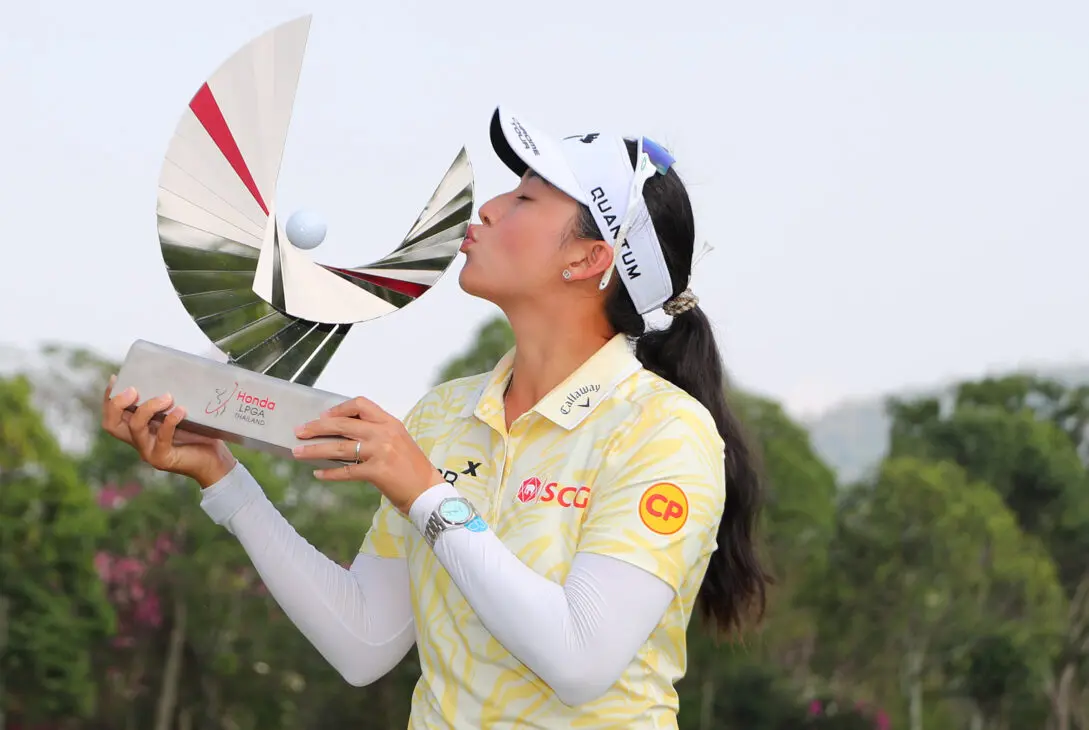
Jeeno Thitikul of Thailand kisses the trophy after winning the Honda LPGA Thailand 2026 in Chon Buri, Thailand. (Photo by LPGA/Getty Images)
By the time Atthaya “Jeeno” Thitikul’s birdie putt dropped on the 17th green at Siam Country Club Old Course, her mother was already crying.
The 38°C air over Pattaya does not forgive. It presses down on you like something deliberate, turns the Kikuyu rough into a sticky trap, and bakes the gallery ropes until they’re warm to the touch. The caddies carry extra towels. The players carry extra everything. And on Sunday afternoon, Atthaya “Jeeno” Thitikul carried eight years of near-misses on Thai soil into the final round of the Honda LPGA Thailand, with her mother watching from inside the ropes for the very first time.
That detail matters. It changes the weight of the thing entirely.
A Promise Kept on the 17th
Jeeno had been here before—seven times, to be exact. Seven attempts to win in front of the people who watched her grow up swinging a club on public courses in Khon Kaen. Seven chances to give her country a moment it had been waiting for since she became the No. 1 player in the world. Seven near-misses, each one filed away somewhere behind those famously unreadable eyes.
Sunday was different from the jump. She came out playing her own game—not aggressive, not passive, just precise. A 67 in the first round was calm enough, business as usual. Then the 63 in round two announced something louder: a player locked in, finding every corner of Siam Country Club Old Course that the heat and the humidity were trying to hide. A 66 in round three kept the hammer down. By the time she stood on the first tee Sunday, she was sitting at -20 for the tournament and had twelve holes of final-round daylight left to deal with.
The problem was Chizzy Iwai.
Japan’s Chizuru Iwai had been a shadow all week, the kind of competitor who makes birdies quietly and then lets the scoreboard do the talking. She entered Sunday at -17, just three back, and on a course this scoreable, three shots is nothing. She was doing more than talking. She eagled the par-5 7th with the clinical efficiency of someone who had practiced that exact shot a thousand times on that exact line, then did it again on the 10th. Two eagles in the span of ten holes. The gallery, overwhelmingly pro-Jeeno, went respectfully silent.
Iwai had put together something monstrous—a closing 66 that would push her final total to -23, 265 for the tournament. A score that would win almost any other week on this tour by two shots.
Then came the 17th.
The par-4 plays longer than its card suggests in the afternoon heat, the fairway bending just enough to punish a player who aims for the wrong corner. Jeeno found the right corner. Her approach was pin-high, maybe eight feet, the ball sitting on a line that she’d clearly already walked in her mind. When it went in, the roar from the gallery wasn’t just noise—it was a release. Five years of pandemic-delayed seasons, of watching Jeeno win everywhere but here, erupted in something close to collective relief.
Her mother, standing with the small family contingent inside the ropes, had both hands over her mouth.
Jeeno, characteristically, didn’t pump a fist or fall to her knees. She tapped in on 18 to close a final-round 68, finishing at -24, 264 for the week—one clear of Iwai, two ahead of Hyo Joo Kim’s solo third at -22. The composure, by this point, is almost unsettling. But when she turned toward the crowd after that last putt fell, she found her mother first.
That was the moment. Not the $270,000 winner’s check, not the trophy, not the ceremony. That was the Honda LPGA Thailand result that will live in the memory of everyone who was standing on that 18th green: Jeeno Thitikul, finally, crying in Thailand.
The Nike Kid and the Grizzled Calm
Well ahead of Jeeno’s group on Sunday, a seventeen-year-old from New Jersey was playing professional golf for the first time in her life and acting like she’d been doing it for a decade.
Gianna Clemente needed a waiver from the LPGA to even tee it up—a formal under-18 exemption that essentially required the tour to sign off on her presence before she could hit a shot in competition. Nike had already signed off in a different way. The Swoosh sat on her hat, on her bag, on her shirt. The “Nike effect” is real in this sport: it signals an organization’s belief that a player isn’t just good now, but will be significant later. Clemente wore it without theater.
That’s what separated her week from the storyline that sponsors love to sell. She didn’t play with the wide eyes of a kid at her first grown-up party. She played with the settled, almost grizzled calm you see in players twice her age—the kind of calm that comes not from lack of awareness but from an excess of preparation. She’s been preparing for this her whole life, and it showed in the way she stood over putts, the way she reset after bogeys without visible distress, the way she talked to her caddie in brief, functional exchanges rather than the nervous chatter of someone trying to talk herself into confidence she doesn’t have.
She finished T53 at -2, 286 for the week. Against a 72-player field of the best women golfers in the world, in tropical heat, on her first professional weekend. Her four rounds in the 70s in this humidity and pressure cooker will mean something to people watching the LPGA Tour ten years from now. The T53 won’t make the women’s golf highlights of 2026, but her debut will be in the notes that scouts and equipment reps take home. You don’t forget a teenager who plays like that.
What Sixteen MRIs Teach You About Patience
While the galleries followed Jeeno back toward the 18th, Cassie Porter was already signing her scorecard. Her T35 finish—-9 for the week, 279 total—is not the story. It never was.
When Porter was seventeen, she woke up one morning on the Sunshine Coast of Queensland unable to walk. Not stiff. Not sore. Unable to walk. The process of figuring out why required sixteen MRIs, a number that sounds almost abstract until you try to imagine a teenager lying still in a tube, again and again, her athletic future uncertain, the surfboards she could no longer carry leaning against the wall of her childhood bedroom.
She rebuilt. She always does. But rebuilt is the wrong word—it implies you return to what you were. Porter became something different. More patient. More willing to tolerate the grind without demanding the result.
Pattaya’s humidity tested that patience physically. The heat by the back nine was the kind that makes your thighs feel heavy and your grip feel wrong. For someone whose body has already staged a full rebellion, the physical grind of a tournament in Southeast Asia is never entirely routine. Porter managed it—nine under par over seventy-two holes, showing up every single day in conditions that had no mercy for anyone, let alone someone navigating the kind of medical history she carries.
She’s also managing a different kind of transition off the course. The Sunshine Coast, for all its beauty, is sheltered—its rhythms slow, its demands gentle. Las Vegas, where she now bases herself, runs on a different operating system entirely. The neon, the noise, the pace. It suits players who’ve learned to tune things out. Porter is learning.
The T35 is fine. The Porter story is still being written.
Six Tees and a Ball with the Right Number
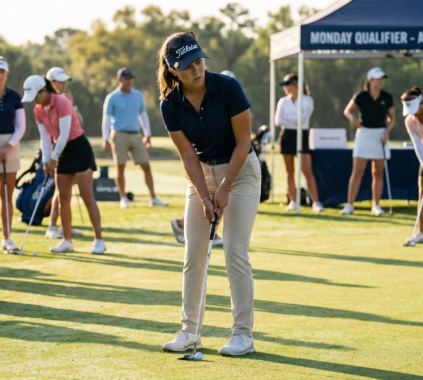
You want to talk about local favorites? April Chanoknan Angurasaranee earned her spot in this field through qualifying—the old-fashioned way—and then went out and posted -12, 276 for the week, finishing T24 and tucking herself into a group that included seasoned tour veterans who have played this course for years.
She walked Siam Country Club Old Course like someone who knows which sprinkler heads to aim for and which patches of Kikuyu play slower than they look. But the superstitions are what the caddies on tour will be whispering about for the next few weeks.
Before every round, April counts exactly six tees into her pocket. Not five, not seven. Six. The number was set years ago and has not been renegotiated. She also refuses to play a ball unless it’s stamped with a 1 or a 4. Other numbers don’t get pulled from the sleeve. They go straight to the shag bag or get handed to spectators. When she found herself late in the tournament with her last 1 and her last 4 sitting uncomfortably in the same pocket, she played both holes with a focus that bordered on ritualistic.
It’s easy to dismiss this as quirk. It isn’t. It’s architecture—a mental structure she’s built around the chaos of tournament golf, giving herself small, controllable certainties in a game that offers almost none. Twelve under par against a full LPGA field on your home course, qualified through the Monday grind. That kind of self-knowledge takes years to develop. April has it.
The Oregon Calculation
Primrose “Prim” Prachnakorn arrived at Siam Country Club carrying double-gold SEA Games momentum and a decision that the Thai golf community is still processing.
She could have turned pro. The offers, the interest, the obvious next step—all of it was there. Instead she chose the Oregon Ducks. She chose to become a college golfer.
The blueprint she’s following belongs to Wichanee “Hut” Vinijchaitham, who made the same calculation, spent four years developing her game in the structured, competitive environment of American collegiate golf, and emerged as a more complete player than she would have been at nineteen on the Epson Tour grind, figuring things out the hard way.
Prim watched that. She studied it. And when the University of Oregon came into the picture, she understood what she was choosing and why. She wasn’t afraid of the pro check. She was strategic about when to cash it.
Her amateur week in Pattaya ended at T65—+6, 294 for the tournament, no prize money collected, not that she was eligible to take any. On paper, those numbers look modest. Against the full weight of a 72-player LPGA field, in 38-degree heat, with seventy-two holes of Siam Country Club Old Course to navigate, they tell a different story. She carried herself without the amateur’s usual telltale tightness and gave people a preview of a player who will arrive on tour in a few years having already answered most of the questions that break young professionals in their first seasons.
The T65 is the starting line, not the finish.
What the Asia Swing Tells Us Now
The Honda LPGA Thailand results will be processed and filed by the statistics teams before the flights to the next stop are even booked. But what this week produced was something harder to quantify than strokes gained.
Jeeno Thitikul finally won on home soil—-24, 264, one shot over a charging Chizzy Iwai—grinding through a Sunday that nearly got away from her, making the birdie that mattered on the 71st hole, and then standing on an 18th green in Pattaya, crying in front of her mother.
Around her, the next generation was making its own marks. A seventeen-year-old with a Nike contract played like a veteran and finished in the black at -2. A local qualifier with six tees in her pocket went -12 and proved she belongs in this field on merit alone. An amateur with a college decision already made showed exactly why she made it. And a woman who once woke up unable to walk finished nine under par in one of the most physically demanding events on the schedule.
The HSBC Women’s World Championship in Singapore is next. The Asia Swing does not stop, does not cool down, and does not offer sentiment. But Pattaya gave this season something that the statistics won’t capture: evidence that the women’s game is not running low on the kind of players who make it worth watching.
The weight of Jeeno’s crown, after eight attempts, is finally where it belongs.







Excellent write up! I was able to watch a little bit of this earlier in the tournament, and it was so cool to watch.
Thanks for reading! It was a great tournament, down to the wire!