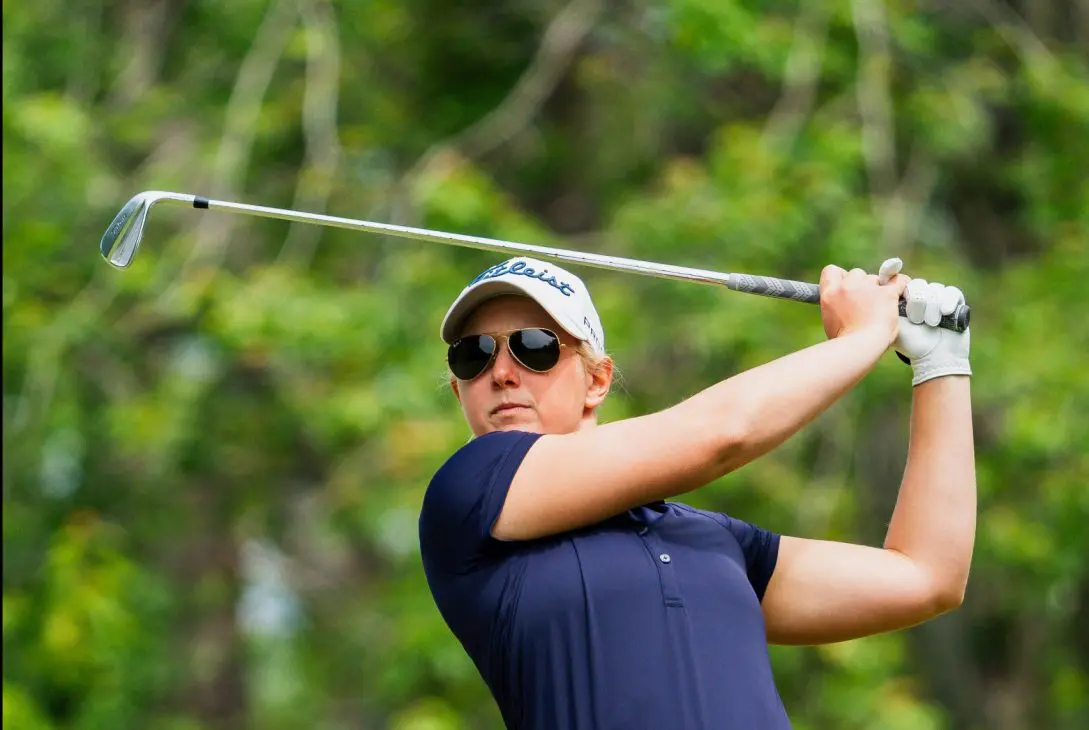
Riley Smyth at the Great Lakes Championship, her second victory of the 2025 season that secured her LPGA Tour card. (Photo: Isaiah Bell / Epson Tour)
From two hip surgeries to $63 from making it, to LPGA glory—the remarkable journey of golf’s most resilient rising star
By Todd Spaziani | Fairwayqueens.com
The Thirty-Foot Putt That Changed Everything
Riley Smyth’s hands were shaking so badly she could see the putter trembling in her grip. It was a Sunday afternoon in January 2025 at the Central Florida Championship, and she was standing over a thirty-foot putt on the second playoff hole against Matilda Castren—an Olympian, a Solheim Cup veteran, an LPGA Tour winner. Castren had just stuffed her approach to a foot. If Smyth missed, her season might as well have ended before it began.
“I’m shaking,” Smyth remembers thinking. “I tapped my putter down, and when I brought it off the ground, I’m like, this thing needs to get back on the ground as quickly as possible because my hands are shaking. I need some stability.”
So she did what she’d learned to do through a decade of surgeries, setbacks, and near-misses: she trusted herself and let it go. The ball tracked perfectly toward the hole, caught the left edge, and dropped.
One hole later, she drained a four-footer to claim her first professional victory, launching a season that would see her win twice on the Epson Tour and earn her LPGA card—mathematically clinching it with a tournament still to play. But to understand why that trembling putt mattered so much, you have to go back to where Riley Smyth’s unshakeable belief in herself was forged: in the backyard battles with three older brothers who never let her win anything.
Forged in Backyard Competition
Riley Smyth was born the youngest of four children and the only girl in a household where competition wasn’t just encouraged—it was unavoidable. Her three older brothers, spaced seven, six, and four years ahead of her, played hockey with a ferocity that carried into every aspect of family life. Who could get to the house first. Who won at backyard wiffle ball. Who dominated at kickball. There was always a winner and a loser.
“There was no way to not be tough in that environment,” Smyth says now. “I definitely had to stand up for myself. Every now and then, it would be three against one, but typically it was two versus two. One of my brothers would always end up backing me up a little bit. So it was a fair fight.”
That competitive fire extended beyond sports. In school, Smyth relished being the first to turn in her tests. Speed mattered more than second-guessing. At some point in middle school, she noticed a pattern: every time she changed an answer, she was changing it from right to wrong.
“So I basically stopped looking back over,” she laughs. “I was like, okay, you know what? We’re just going to go for speed. If I’m not double-checking this, we might as well do this as fast as we can.”
That instinct—trust your first read, commit fully, never look back—would become the foundation of her golf career.
A Sport That Grew on Her
Golf entered Riley Smyth’s life not as a calling but as a convenience. The family belonged to a country club that offered summer camps, and for Gwen and Kevin Smyth—Riley’s parents, both now retired—dropping all four kids off meant a few precious hours of peace in what was otherwise a “very, very chaotic house.”
Riley swam. She played tennis. She took golf lessons. But basketball was her sport, the one she loved, the one she played until her junior year of high school. Golf felt slow, solitary, disconnected from the team camaraderie she craved.
“What kid is super excited about going and playing golf instead of soccer or basketball with their friends?” she asks. “It’s hard to really get that excitement level in an individual sport when you’re six to ten years old. When you see all of your friends out playing another sport together.”
What made the difference was playing with family—heading out in late afternoon threesomes with her parents and brothers, turning the solitary game into something social. And there were the coaches at the club who saw something in her swing, a natural movement that suggested untapped potential. Their confidence became her confidence.
The real turning point came the summer after her freshman year of high school, after the family had moved to North Carolina. That’s when she found Robert Linville.
“He saw potential way beyond anything anybody had ever said to me. He saw potential of me being able to play at a high level in college, and if I put in the work, being able to play professionally.”
Smyth and Linville have now worked together for nearly eleven years. He would become not just her swing coach but her steadying presence in moments of doubt, the person she called first after her breakthrough win. But in those early days, he was simply the first person who made her believe that professional golf wasn’t just a fantasy.
There was just one problem: Riley Smyth was surrounded by players who were already better than her.
Grinding in the Shadow of Stars
In the Research Triangle of North Carolina, within twenty minutes of Riley Smyth’s home, lived Gina Kim, Jennifer Chang, and Amelia Migliaccio—three golfers who would go on to become some of the most decorated amateurs of their generation. They were in her grade or just above. They were winning everything.
“They took off way earlier than I did,” Smyth recalls. “And so you sit in there and you’re like, okay, they’re going to be stars in college. They’re going to go turn pro and have success professionally. And I’m just grinding to try to keep up.”
Many young golfers, faced with such overwhelming local competition, would have pivoted to something else. Why pour your heart into a sport where you’re not even the best in your area code? But Riley Smyth’s parents had raised her with a simple philosophy, one forged in those backyard battles with her brothers.
“There’s no such thing as quitting.”
Her parents always believed she could do it. They drove her ninety minutes each way to see Coach Linville, spending entire afternoons on the road. They spent weekends at tournaments. They helped her find trainers, physical therapists, putting coaches, short game specialists—anyone who could help her close the gap.
“They’re just super, super proud of me being able to have the work pay off,” Smyth says of her parents. “I had a lot of battles to fight and a lot of hills to climb to get there.”
She had committed to the University of Virginia as a sophomore, before she’d established herself as an elite junior player. It was a leap of faith by both parties. Then, just as she was beginning to hit her stride, her body failed her.
When Your Body Becomes Your Enemy
The pain started as tightness. For months during her junior year of high school, Riley Smyth stretched and foam-rolled and saw physical therapists, convinced her hip was just tight. It slowly got worse, but her pain tolerance—forged through years of being thrown around by her brothers—masked the severity.
“Growing up with brothers, I have a super high pain tolerance because you get thrown around all the time,” she explains. “And you know, also, we had a bunch of injuries in the house growing up, and so it’s like, ‘Is that actually really hurting you that you have to see a doctor? No? Okay, go to school, you’re fine.’”
But one tournament changed everything. She finished her round and walked to the car, then realized she couldn’t lift her leg to get in.
“Mom, I can’t get this leg in,” she told her mother. “I have to go see a doctor.”
The diagnosis was devastating: a torn labrum caused by bone impingement—a genetic condition where extra bone in her hip socket slowly wore down the cartilage. She needed surgery, followed by four months of rehabilitation, a month on crutches, and a complete halt to competitive golf.
The hardest call was to Kim Luellen, Virginia’s head coach at the time. Smyth had committed, but she hadn’t signed yet. Her spot could vanish.
“She couldn’t have been better about it,” Smyth remembers. “She was like, your spot is not a problem at all. We’ve actually had a couple girls that have had surgery come through here, and when they come out the other side, they’re even better than they were—because of all the work they put in off the course during their rehab process.”
Smyth recovered. She started to feel like herself again. She was preparing for her senior season when she pivoted on her left hip while throwing her backpack into her car after school.
“I just felt the hip blow,” she says. “I get in my car and I sit down and I call my mom. I go, ‘We gotta go see the doctor, the other one’s blown.’ She’s like, ‘No, there’s no way.’ I’m like, ‘Yes.’”
The same surgery. Another four months of rehab. Another month on crutches. She missed her entire senior season, watching from the sidelines as her high school team won the state championship without her.
When she arrived at the University of Virginia, she couldn’t walk properly or swing a club.
Finding Herself in Charlottesville
Riley Smyth spent five years at Virginia, using a COVID eligibility year to extend her career. She rehabilitated, she competed, she grew—though not always in ways that showed up on leaderboards. Her final season at UVA, she never finished higher than 36th in any tournament.
“I was playing some pretty decent golf,” she insists. “I just was not scoring very well.”
She lost her lineup spot before ACCs and Regionals that year, relegated to traveling as the team’s substitute—present but not playing. For six weeks before NCAAs, she didn’t compete in a single tournament round.
Then came NCAAs. A spot opened. And in her final round as a Cavalier, Riley Smyth shot 71—the team’s low score of the day—with two eagles.
“That definitely being able to close out my college career with that round really, really felt like a sweet end,” she says. “And just be able to have a little bit of momentum to have my first pro start the following week.”
For context on just how talented Riley Smyth is when her game is clicking: she has four career hole-in-ones. Three of them came in tournament play. That’s not luck—that’s someone with serious shotmaking ability who rises to the moment when it matters.
But between those hip surgeries and that final round lay another moment that shaped who Riley Smyth would become: the 2020 U.S. Women’s Amateur, a tournament she almost didn’t enter.
The Chick-fil-A Revelation
The 2020 U.S. Women’s Amateur was different. COVID had eliminated qualifying. The field was filled entirely through exemptions—tournament winners, top-ranked amateurs, the elite of the elite. The USGA added a category for the top 75 players in the Wagr rankings who applied.
“A lot of people saw that and saw, oh, top 75, I’m not gonna get that,” Smyth remembers. “So I was like, you know what? What’s the harm in applying? And if I don’t get it, that’s kind of what I was expecting.”
She was driving home one day, stopped at a Chick-fil-A drive-through, and checked her email while waiting in line. There it was: “You’ve earned a spot in the U.S. Women’s Amateur.”
“I’m like, no, what?” she recalls. “Is this a mistake? I get home and I’m like, ‘Mom, Dad, I just got into Women’s Am.’ They’re like, ‘No. Are you pulling our leg?’”
Because she’d gotten in unexpectedly, Smyth arrived without pressure. She had nothing to lose. In stroke play, she fired a 68 to co-lead the field. She advanced to match play and kept winning, coming back from two down with five holes to play in one match to reach the quarterfinals.
More than the results, the week taught her something essential.
“I belong out here. I still have a lot of work to do, but I belong with this group. I can do this.”
Riley Smyth’s Rock Bottom: Sixty-Three Dollars from Making It
Riley Smyth turned professional the week after NCAA Nationals in 2023. Her brother caddied for her at her first Epson Tour event in North Carolina. She had momentum from that final college round. She had belief.
She finished her rookie year 101st on the money list—$63 outside the top 100, which would have guaranteed her status for the following season.
Sixty-three dollars. One missed putt over the course of a season. That’s all that separated her from security.
“I knew I didn’t want to be in that position again,” she says. “And so, you know, took a little bit of time off just to regroup myself, but I was like, you know what? I’m gonna make sure that when I do get starts next year, I’m not gonna be close to the 100 number.”
The 2024 season brought new challenges. She started as an alternate—sixth on the list—and didn’t expect to get into tournaments. When her friend Kaylee Telfor half-jokingly asked if Smyth would caddy for her if she didn’t get into the next event, Smyth said yes.
What developed was one of those friendships that makes the grind of developmental tour golf bearable. Smyth would show up to tournaments hoping to play, and when she didn’t get in, she’d grab Telfor’s bag and loop for her instead—no payment expected. They’d share reads on putts that neither of them was entirely sure about. They’d talk each other through bad shots. They became each other’s support system in a sport that can feel brutally lonely.
“We definitely had an agreement,” Smyth laughs. “If I have no idea what’s going on, neither does she. And if I didn’t have any idea and she was committed on a line, we were going with that.”
She even caddied for Telfor to a second-place finish at one event—a bittersweet result when the tournament was shortened to 36 holes due to rain delays, robbing Telfor of a final-round chance to win.
The friendship went both ways. When Smyth won her first tournament, Telfor was there. When she won her second, Telfor was there again—racing back from her host house just in time to see the playoff finish in Winter Haven. In a sport where everyone is technically competing against everyone else, the two women had found something more valuable than another practice round: genuine sisterhood.
“She’s got some great things ahead of her,” Smyth says of Telfor. “She’s a super solid player. And she’s really happy for me, which was really special to see.”
For weeks, caddying gave Smyth exactly what she needed. It wasn’t defeat—it was strategy. It kept her in the competitive mindset, kept her brain working through tournament situations, kept her from going stir-crazy while waiting for her chance.
“It gave me something to do,” she explains. “Okay, yeah, I may not be hitting the shots, but I’m having to think through, I’m having to deal with the emotions of a tournament round—whether that’s talking Kaylee through her emotions, or trying to just kind of settle in of what the situation is and what shot we have to play. It kind of just got my brain working in that environment again.”
She even caddied for Telfor to a second-place finish at one event.
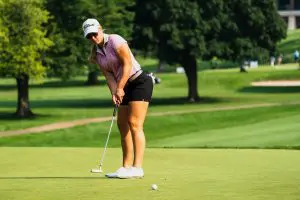
Riley Smyth competing on Epson Tour during 2025 breakthrough season. (Photo: Isaiah Bell / Epson Tour)
Riley Smyth’s Breakthrough: The Wins That Changed Everything
The 2025 Epson Tour season opened with the Central Florida Championship at the Country Club of Winter Haven. Riley Smyth arrived without expectations.
“If you had asked me at the start of the week if I had a chance to win that tournament,” she says, “I’d been like, I’m a competitor, so I’m always gonna say I think I have a chance. I’m not showing up to a tournament if I don’t think I have remotely a chance. But I’m not playing well enough for that. I need some things to go my way.”
Things went her way. She played her way into a playoff with Matilda Castren, whose credentials she wouldn’t learn until after the tournament was over.
“I really hate to say it because I should know more about women’s golf,” she admits, “but fortunately, I didn’t.”
The playoff was played on the 18th hole, over and over. By a stroke of luck, Smyth’s putts kept landing on nearly the same line she’d faced at the end of regulation. She’d overplayed her first read, but she learned from it. When she faced the thirty-footer to stay alive on the second playoff hole, she knew exactly what to do.
“Graham,” she told her caddy, “it’s basically the same putt. I just hit this putt thirty minutes ago. I played it too high. You know what we’re going? I know what I’m doing.”
She made it. One hole later, she made her four-footer to win.
Her first call was to Robert Linville, her coach of eleven years, the man who first told a sophomore in high school that she could play professionally.
“Being able to share that moment with him of all the work we’ve put in, all the struggles that we’ve gone through,” she says. “That was definitely super, super special.”
She couldn’t celebrate properly that night. She’d checked out of her Airbnb that morning and had a three-hour drive to Jacksonville, where her aunt and uncle were waiting. She spent the drive making phone calls, sharing the news with everyone who’d believed in her.
Her second win, at the Great Lakes Championship, was different. She didn’t feel great entering the week. Her game wasn’t clicking. But she figured it out on the fly, birdied 15 and 16 to take the lead, then faced the shot she’d been dreading for nine holes: a 200-yard approach over water on 18.
“I’m walking off 17 and all I can think about is the shot that’s coming up,” she recalls. “Which is the worst thing to do in that moment. I’m thinking about all the ways it can go wrong.”
Her caddy started talking about something—she can’t remember what, her mind had blacked it out—just to get her thinking about anything else. She pulled a six-iron, made solid contact, and watched the ball track toward the green.
“I’m like, please be the right number. It’s up in the air. It’s looking good. I’m still holding my breath. It finally lands on the green and I’m like, oh my God. That was the biggest sigh of relief all day.”
The second win was validation.
“The first one’s getting over the hump. The second one is validation: okay, the first one wasn’t a fluke. I can do this.”

Alt Text: Riley Smyth celebrates her first Epson Tour win March 2025. (Photo: Isaiah Bell / Epson Tour)
The Struggle Nobody Sees
Even in a season with two wins, Riley Smyth hit rock bottom.
Midway through 2025, with her LPGA card within reach, she started missing cuts. The pressure of the outcome—the card she’d been chasing her entire career—consumed her. She got so focused on the destination that she forgot why she started the journey.
“I got so in my head about getting my card and possibly losing that opportunity,” she says. “I’m so focused on outcomes, I just lost sight of the fact that golf is supposed to be fun. Lost sight of my why and my values in the game.”
Her support system pulled her through. Friends, coaches, her caddy—they all told her the same thing: let it go. Go play golf. Have some fun. We’ll figure the rest out.
Coach Linville came out to a tournament and reminded her of a story from early in their work together. He’d watched her shoot an ugly 76, and afterward, when people asked how she played, she’d said, “Played great.”
“He’s sitting there in his head like, she played terrible today,” Smyth laughs. “But that was kind of his first thought of, wow, she’s got a strong mental game. The score doesn’t matter. If you feel like you played great, you’re probably gonna play better.”
That’s the mindset that defines Riley Smyth. She can be in the trees, can be anywhere, as long as she’s in bounds.
“I don’t really care where the ball goes off the tee,” she says. “I can be in the trees. As long as I’m in bounds, I’m gonna find a shot. I just had to get back to playing my game and playing for the love of the game, rather than playing for the outcome.”
The Card
On September 23, 2025, Riley Smyth mathematically clinched her LPGA Tour card with one tournament remaining in the Epson Tour season. She was still at the course in Arkansas, having just played 26 holes and missed the cut by one stroke.
The tour’s media team found her.
“Well, fortunately, you got a good personality,” they told her, “because we gotta interview you right now. We saw the leaderboard. We’re self-aware enough to know that you’re probably outside the line by one right now. If you don’t want to do it now because your mood’s like that, that’s fine.”
She did the interview. This was the positive on a bad day.
Her first call was to her parents. They’d been doing the math for weeks, watching the points accumulate, waiting for the moment when their daughter’s lifelong dream became official.
Even then, she couldn’t quite believe it.
“There was no chance I was going to believe it until the card was handed out at the ceremony,” she admits. “You hear a lot of stories of people that fall out. You don’t want to let your guard down and somehow it magically slips away.”
It didn’t slip away. Riley Smyth is now an LPGA Tour member, the fourth Cavalier from Virginia to reach the tour. Her first event will be in China. Her goals for 2026: play in all five majors, keep her card, and maybe—just maybe—make the Solheim Cup team.
“Growing up, whatever sport I was playing, I always wanted to be able to represent the US on an international level,” she says. “Obviously, being able to play a Solheim Cup would be a dream come true.”
First Day of School All Over Again
For all her mental toughness, Riley Smyth is refreshingly honest about being scared.
When she talks about joining the LPGA Tour, the confidence gives way to something more vulnerable. She’s been working with her mental coach to prepare, and she describes the feeling in terms anyone can relate to: first day of school anxiety.
“It’s like being at a new school,” she admits. “You might know some people, you don’t know everyone. Things are different. You’ve got new courses, new cities, new places to stay, new flights. You’re playing practice rounds with different people. There’s so much that’s different that it is kind of that first day of school anxiety of, oh my God.”
She laughs and adds: “You have that dream where you forgot to put your pants on.”
It’s a disarming admission from someone who just won twice and earned her tour card with a tournament to spare. But it’s also what makes Smyth so relatable. She’s not pretending to have it all figured out. She’s not performing unshakeable confidence for the cameras. She’s a young woman about to take the biggest step of her professional life, and she’s nervous about it—the same way anyone would be.
What gives her comfort is knowing she’ll see familiar faces from the Epson Tour who’ve already made the jump, and that rookie orientation will answer the questions she hasn’t even thought to ask yet.
“I think it’ll settle in once I’m actually out there,” she says. “Getting things started is always a little scary for me. But you know, everybody from Nelly Korda to Gina Kim—they’ve all been in my shoes. Every year, there’s new people.”
What You See Is What You Get
Off the course, Riley Smyth watches Stranger Things and re-runs of Gilmore Girls. She shoots hoops to clear her mind. She plays tennis and pickleball. She values the rare days when she can just sit around and do nothing, because those days are precious when you’re constantly on the move.
She lives in Tequesta, Florida, and holds an economics degree from Virginia. Her three brothers all went into finance and real estate. If golf didn’t exist, she says she’d probably be doing something similar—but she’s never really thought about it. Once professional golf got into her head as a goal, there was no Plan B.
“I have tunnel vision like no other,” she says. “So once it got in my head that I was playing pro golf, there is nothing else that even crossed my mind.”
When asked what she wants people to know about Riley Smyth the golfer that they might not see from the outside, she pauses. The answer, when it comes, is characteristically direct.
“I feel like, for the most part, what you see is what you get. I’m never gonna hide who I am.”
What you see is a golfer who was never the most naturally talented player in her area, who underwent two hip surgeries before she could legally vote, who finished $63 outside security in her rookie year, who caddied for a friend when she couldn’t get into tournaments, who won twice and earned her LPGA card and still found herself struggling with self-doubt in the middle of her best season.
What you see is someone who never quit.
Riley Smyth’s Future: What’s Next for Golf’s Rising Star
Riley Smyth will tee it up on the LPGA Tour for the first time in early 2026, carrying with her everything she’s learned from her brothers, her parents, her coach, and the long, winding path that brought her here.
She knows there will be hard times ahead. There always are. Golf is hard, and the LPGA Tour is harder. She’ll face new courses, new competitors, new pressures. She’ll probably have stretches where nothing goes right, where she questions everything, where she has to find her way back to the love of the game.
But she’s faced all that before. She knows the formula now.
“It’s all just such a learning process,” she says. “Okay, this is what I do when this happens. Whether it’s working on your swing—okay, if I’m hooking the ball, this is what I do—it’s the same of, if this is what’s going on in my mind, this is how I fight it.”
Standing on that first playoff hole in Winter Haven, shaking hands gripping a putter over a putt she had to make, Riley Smyth didn’t know she was facing an Olympian. She didn’t know her season would include more triumphs and struggles still to come. All she knew was what she’d always known, the lesson her parents taught her in a house full of competitive brothers, the truth that carried her through surgeries and setbacks and a rookie year that ended $63 short.
“That’s kind of always been a big motto of mine. I’m gonna make sure I do everything that I possibly can to achieve my goals. That’s how I was raised. There’s no such thing as quitting.”
The LPGA Tour better be ready. The unbreakable Riley Smyth has arrived.
— END —