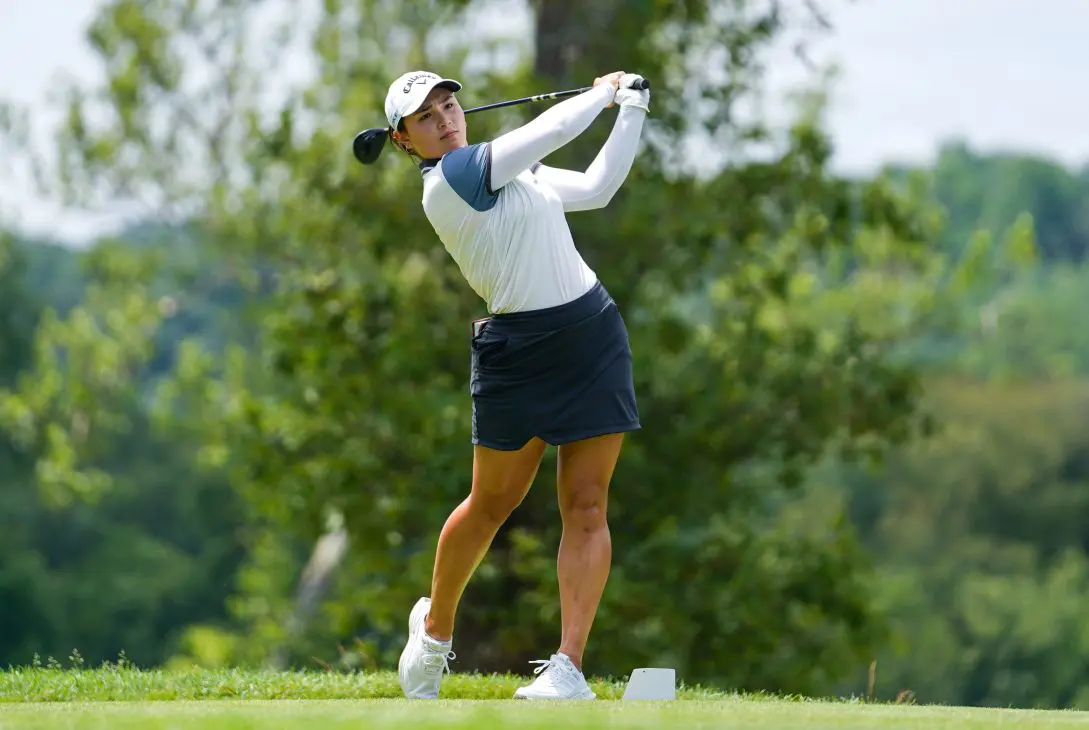
Camille Boyd Tees off during the 2025 Hartford HealthCare Women’s Championship (Photo: Isaiah Bell / Epson Tour)
Camille Boyd’s journey to the LPGA Tour took her across three continents before earning her 2026 card at Q-Series. This is the story of her rise through the Epson Tour.
PART I: THE FROST DELAY — 2025 LPGA Q-SERIES
You have to understand the cold at Magnolia Grove to understand what happened there. It wasn’t just a chill; the ice had settled over the grass in Mobile, Alabama, like a final insult from the golf gods. It was December 9th, 2025, and the rain had already been a nightmare—enough to chop the most important tournament of the year from 90 holes down to 72.
And Camille Boyd? She was already awake.
She had been up early every day that week—packing the bag, driving to the course, walking into the clubhouse. Routine. She arrived ready to fight for one of only 25 spots on the LPGA Tour.
Then she looked at her phone. Frost delay. Two more hours.
So, she sat there. Just her, a coffee, and the nerves. She watched the other 115 women filing by, all chasing the same dream. Outside, the Robert Trent Jones Golf Trail looked perfect—frozen solid, indifferent to the stakes, but perfect.
“I didn’t check my phone of course. So I got there and was waiting there for two hours.”
She was tied for fifth with eleven holes left. That was the gap between her and everything she had spent the last 15 years grinding for. Or the last five, if you count her time at Washington. Or really, just the last week of pure misery.
Ryann O’Toole, a 15-year veteran fighting for her job alongside the rookies, called it “the hardest tournament I’ve ever played mentally.” Players spent six hours in the clubhouse just to play four holes. You can’t warm up. You can’t focus. You just wait, trying not to think about the math changing on the leaderboard.
“Every time you make a bogey it feels like the end of the world,” a player said.
But Boyd? She knows how to wait. She knows how to adjust when things get uncomfortable. This was just the same lesson she’d been learning since she was a kid on a 12-hour flight across the Pacific.
When the frost finally melted, she didn’t panic. She made a birdie.
“That kind of settled my nerves,” she said.
The final round wasn’t flashy. One birdie, one bogey. That was it. The leaderboard was tight. But she parred her way in. She shot 72. One of 31 women to earn a 2026 LPGA Tour card.
She called her mom from the 18th green.
“I think she was maybe tearing up. That moment was very surreal… I was pretty shocked but I didn’t cry.”
But here is the thing about Camille Boyd: Q-Series wasn’t the start of the struggle. It was just the final checkpoint in a life lived in the gray area between cultures—a journey that went from Tennessee to Shanghai to Seattle, filled with bent putters, corporate job offers, and a refusal to be normal.
PART II: THREE CONTINENTS — GROWING UP IN SHANGHAI
To get Camille Boyd, you really have to get the geography. Born in Tennessee, paperwork says Yorba Linda, California, but the real answer is complicated. Her dad was a medical equipment executive who moved often. China. Japan. California. Then high school in Shanghai.
Ask Boyd where she is from, and she won’t give you a simple city name. She gives you a disclaimer.
“When people ask me where I’m from, it’s always a complicated answer,” she says. “The majority of my life I’ve lived in Shanghai, but when I tell people that, they assume I have Chinese nationality. And then they’re like, ‘Oh, your English is so good.’ And I’m like, yeah, because I’m from America.”
She laughs the laugh of someone who has had this conversation five hundred times.
“So I just tell them I’m from California to kind of ease that conversation a little bit.”
She calls herself “a product of a multicultural environment.” As a kid, she hated it—the moving, the restarting, the being the new girl. But looking back, it built armor.
“I think it definitely helped me in the long run with social skills,” she says. When she got to the Epson Tour—a place where you’re often alone in a town you don’t know—it didn’t rattle her. She is used to being the outsider.
She picked up golf at 10. Late, by today’s standards. But golf traveled well. The rules in Shanghai are the rules in Yorba Linda. There was just one catch: if you are an American citizen playing junior golf in China, there is a ceiling.
“They want to give the best exposure to the Chinese players. Which you know you can’t blame them for,” she says. “So when I was getting better and started popping up towards more the top of the leaderboards, that’s when they told me I couldn’t play anymore.”
So she became a commuter. Summer breaks, winter breaks, skipping school for invitationals. Twelve hours from Shanghai to LA to play AJGA events. Twelve hours back. Her dad logged the miles; she logged the rounds.
PART III: THE HUSKIES — THE FLOP SHOT VS. THE IRON
When college rolled around, she landed at the University of Washington in 2020. And just like the frost delay, things didn’t start smoothly. Freshman year was rough. She had a 76 scoring average and a putter that felt cursed.
Later that year she found the problem: The loft was off. Just one degree. Not enough to look broken, but enough to miss.
“Playing the whole season with one degree of loft on your putter? Like I was not making any putts.”
It wasn’t just the club. It was the pressure. Washington had won a national title in 2016; you don’t go there to shoot 76.
Enter Mary Lou Mulflur.
Mulflur is a legend in the Pac-12. Forty-one years at the helm. She is old school. Boyd tells a story about chipping practice that perfectly captures how Mulflur shaped her game. Boyd wanted to hit a fancy wedge shot from thirty or forty yards out.
“She was like, just use an iron,” Boyd recalls. “Very old school. And I was like, no, I’m not gonna do that. I’m just gonna flop it there, hit it close to the pin.”
Mulflur didn’t argue. She just reached into the bag, grabbed an iron, and chipped it to within an inch of the hole.
“That was the biggest shut-me-up thing ever,” Boyd laughs.
Mulflur saw something in Boyd, even through the freshman struggles. Before the 2022 Juli Inkster Invitational at Meadow Club, Mulflur pulled Boyd aside. She didn’t offer swing advice. She offered a prediction.
“I think we were having a conversation about maybe it was my time,” Boyd recalls. “Something was going to happen for me.”
Mulflur was right. Boyd overhauled her mental game. She stopped obsessing over the scorecard and started visualizing. In the final round, lurking a few shots back was Rose Zhang, the number one amateur in the world. Zhang fired a course-record 64.
Boyd, playing behind her, had no clue. She just kept making birdies. She signed for a 65. Fourteen under par. A new school record. She beat Rose Zhang by three.
“Coming down the stretch the last day, it didn’t dawn on me how good I was playing numbers-wise. It just felt like an average good round.”
Later that year, Juli Inkster herself was in the commentary booth and called Boyd’s swing “a treat to watch.” For Camille Boyd, the commuter kid from Shanghai, the imposter syndrome was officially gone.

Camille Boyd poses with her runner-up trophy at the Dr. Donnis Thompson Invitational during her senior year.
PART IV: THE DECISION — TURNING DOWN CORPORATE AMERICA
Here is the thing about the jump to professional golf—it wasn’t inevitable. By the end of her junior year, Boyd was exploring life outside the ropes. She participated in a student-athlete leadership experience with Deloitte. She met a woman in the industry and thought, Yeah, I could do that.
“I wasn’t as certain about this career as maybe some of my peers were in college,” she admits. “I was seriously not considering turning professional.”
She looked at LinkedIn. She saw her friends building resumes. She worried she was falling behind in the “real world.” But then she had the realization that saves so many athletes from a desk job. She talked to her dad, she talked to her coaches, and the answer became clear.
“Through these conversations, I realized that life is waiting for me when I’m done with my career. That’s always going to be there. But to play professional golf straight out of college… this is the best I’m gonna be.”
So she chose the grind. And the Epson Tour is absolutely a grind.
It’s a relentless proving ground where, if you aren’t in the top 15, you are losing money. Boyd is honest about it: without her parents, it wouldn’t have happened.
“There’s no way I could have done it honestly without my parents’ support,” she says. “Like, I wouldn’t even know where to start.”
She made 15 cuts in 20 starts. She stayed in bad Airbnbs—one in Florida was so grim she barely wants to talk about it, booked last minute because she wasn’t sure she’d get off the reserve list.
“Pretty slim,” is all she calls the options.
It wasn’t glamorous. She learned the hard way about isolation. She also developed her own quirks to survive. She carries a tiger’s eye crystal. She won’t eat trail mix on the course because the loose nuts might “scatter” her shots. (Bars are fine. Loose nuts? No go.)
“I think my mom probably planted the idea in my head when I was playing junior golf,” she laughs. “But I never eat trail mix or nuts.”
PART V: THE ARRIVAL — EARNING THE CARD
The 2025 Q-Series proved that history likes to repeat itself. Just days before the biggest tournament of her life, Boyd checked her equipment.
Her irons were two degrees open.
“When you know in your gut something’s wrong, it’s usually wrong,” she says.
She scrambled to fix them. Just like the putter at Washington, she wasn’t going to let equipment derail her. She trained in the Seattle rain with her friend Sarah Rhee to prepare for the miserable weather.
“I remember like on this random day it was pouring and we were like let’s just go play 18 holes because we knew that the conditions at Q school were gonna be bad,” Boyd says.
They were right. The rain came. The frost came. But Boyd was ready. She fought through the washouts. She fought through the suspended play. And when she walked off the 18th green, she had done it.
Her dad was there. Her caddie was there. Her mom wasn’t—by design.
“I didn’t really want too many outside factors.”
Now Camille Boyd is here. Card in hand. A member of the LPGA Tour rookie class 2026. She is still in Seattle for the off-season, hiking, doing yoga, listening to Drake, and trying to keep her world bigger than just a golf score.
“We’re in a weird situation where our job is so ingrained in our day to day life,” she says. “It’s not like we can just you know like leave work, clock out and just forget about it.”
When asked what she’d buy with her first big check, she didn’t mention a car or a Rolex.
“A nice meal for whoever I’m with at that moment,” she says. “Just to show my love for the people that have helped me get this far.”
And if it’s a really big check?
“Depends on how big,” she chuckles. “But still probably a nice meal. Just a nicer one.”

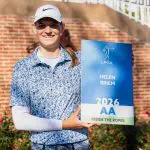
Officially a Rookie. After a grueling week of rain and frost delays in Mobile, Alabama, Camille Boyd has earned her spot on the LPGA Tour.
EPILOGUE: CAMILLE BOYD’S MESSAGE
Before we finished, I thought about the 15-year journey. The three continents. The flights. The “no” from the Chinese federation. The corporate job she almost took.
I asked her how it felt now that the frost has melted and the card is in her pocket.
“I did earn it and it’s not always easy, like it’s pretty isolating to be honest. But it beats what a lot of other people are doing.”
She paused, thinking about the office job she didn’t take.
“I am very happy.”
Camille Boyd begins her LPGA rookie season in 2026. She still checks her clubs before every shot, and she still refuses to eat loose nuts on the course.